
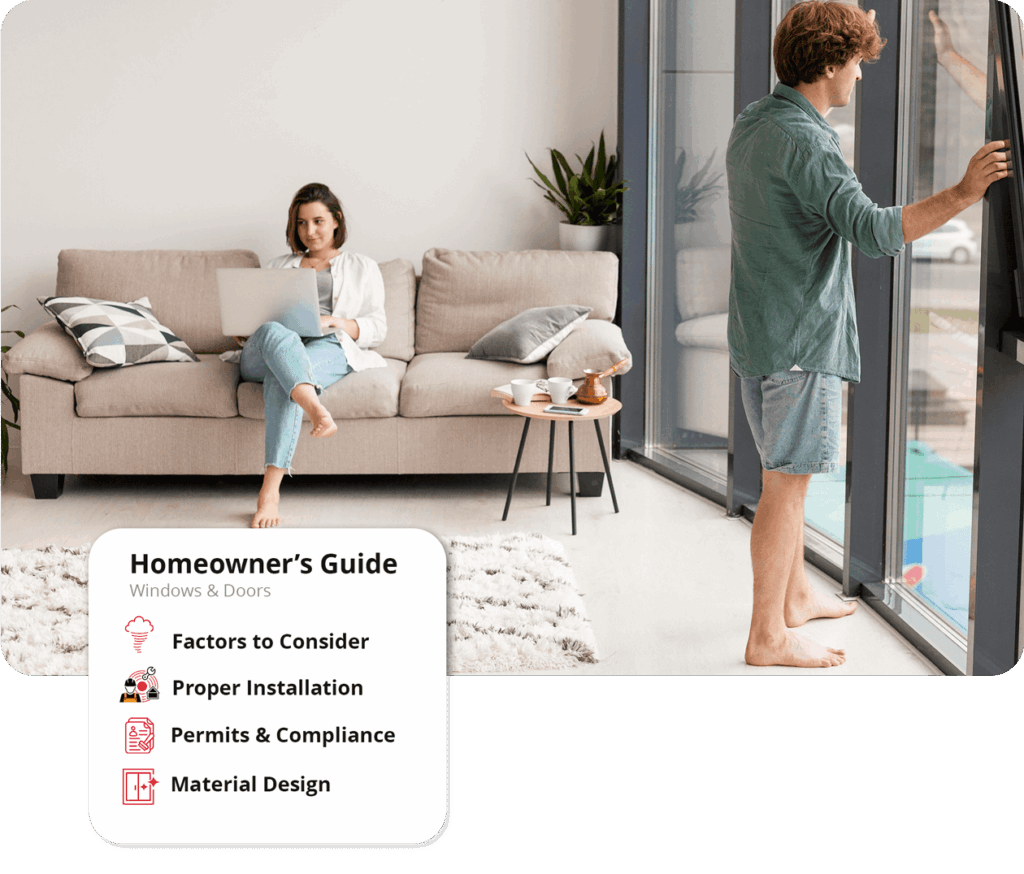


Are you about to upgrade your home’s windows and doors or are considering it? After installing more than 2,000 windows, we know a thing or two about materials and installation. Hang tight and read through this guide.
We get it: understanding when to renovate your windows and doors and which contractor to pick can feel overwhelming. But it’s one of the smartest ways to offset rising energy bills, outdated aesthetics, knockoff lack of security and outside noise. Without a plan in place is easy to get lost with the vast selection of windows to pick, overpay, and overlook the installation process. We’ve put together this step-by-step guide to help you start planning your windows renovation—because homeowner education starts here. Let’s get started!
Consider impact windows as armor for your home. Standard impact glass is manufactured by taking two panes of glass and sealing them together at very high heat with a unique plastic layer (PVB) in the middle. This technology was actually derived from automobile windshields – when a projectile strikes it, the glass may crack, but it remains intact rather than flying everywhere. Here is what you need to know regarding thickness:
Most homeowners opt for 7/16" since the cost difference is generally only $50-100 per window, yet the upgrade in protection is tremendous. Miami-Dade County mandates the hardest standards in the nation - these windows are struck with a 9-pound piece of wood traveling at 50 mph, then subjected to thousands of pressure cycles to mimic hurricane-force conditions.
Low-E (Low Emission) glass is sunglasses for your home. It contains a microscopic coating that bounces heat back outside during summer but allows light to pass through. Here is what the various tints signify:
The most important figures to grasp: U-Factor: Lower numbers indicate better insulation (seek 0.30 or less). Solar Heat Gain Coefficient (SHGC): For Florida, you need 0.25-0.30 to keep heat out.
This advantage may surprise you the most. Impact windows typically carry STC (Sound Transmission Class) ratings of 32-38, whereas standard windows carry 18-20 ratings. What that translates to in everyday life: If you now hear every trash truck, motorcycle, or neighbor’s dog, impact windows will cut that noise by roughly 90%. The noise reduction is due to:
“Our electric bills went down around $80 a month after we put in Low-E impact windows. During Florida summers, that adds up quickly – we’ve saved $1,400 already this year alone”.
If you live in a community with a Homeowners Association, getting approval isn’t optional – it’s required, and ignoring this can cost you big time. Your HOA wishes to preserve the neighborhood’s visual continuity in order to safeguard everyone’s property values. They generally care about:
Start early – this takes 30-60 days. Here is what successful homeowners do:
We keep track of impact windows that have been approved previously for each HOA that we deal with. This saves homeowners months of waiting and negotiations with architectural review boards.
You can buy the most expensive impact windows in the world, but if they’re installed wrong, they might perform worse than cheap windows installed correctly. Critical Installation Factors:
Permits are needed for most coastal regions to install impact windows – and foregoing this leads to trouble:
The Permit Process:
Florida Building Code explicitly demands that impact windows pass rigorous installation requirements, such as correct flashing and fastening techniques. Prior to installation, ensure your windows have the necessary certifications for your region:
Permits are needed for most coastal. Questions to ask a contractor under consideration:
Experience & Proper Documentation:
Project Timeline & Details:
Payment Processing: